

What is the heat resistance of a Steel 3 Drawer Filing Cabinet?
Jul 16, 2025
Leave a message
When it comes to storing important documents and files, a Steel 3 Drawer Filing Cabinet is a popular choice for many offices and businesses. One crucial aspect that often concerns users is its heat resistance. As a supplier of Steel 3 Drawer Filing Cabinets, I am well - versed in the technical details and performance of these cabinets, and I'm here to share some in - depth knowledge about their heat resistance.
Understanding the Basics of Steel and Heat Resistance
Steel is an alloy primarily composed of iron and carbon, with other elements added to enhance its properties. The heat resistance of steel depends on several factors, including its chemical composition, the manufacturing process, and the presence of any additional coatings or treatments.
Most of the Steel 3 Drawer Filing Cabinets we supply are made from high - quality cold - rolled steel. Cold - rolled steel has a smooth surface finish and better dimensional accuracy compared to hot - rolled steel. It also has relatively good heat - resistant properties. The carbon content in the steel used for our filing cabinets is carefully controlled to ensure a balance between strength and heat resistance. A higher carbon content generally increases the strength of the steel but may reduce its ductility and heat - dissipating ability. Our steel is formulated to maintain a stable structure under normal and moderately high - temperature conditions.
Heat Resistance Performance in Different Situations
Normal Office Environment
In a typical office environment, the temperature usually ranges from 20°C to 25°C (68°F to 77°F). Under these conditions, a Steel 3 Drawer Filing Cabinet experiences no issues with heat. The steel structure remains stable, and there is no risk of deformation or damage to the stored files. The cabinet's surface may absorb a small amount of heat from the surrounding air, but it quickly dissipates due to the relatively large surface area of the steel and its good thermal conductivity.
Fire - Related Situations
One of the most critical scenarios where heat resistance matters is in the event of a fire. Our Steel 3 Drawer Filing Cabinets are designed to provide a certain level of protection to the contents inside during a fire. The steel acts as a barrier, slowing down the transfer of heat to the interior of the cabinet. However, it's important to note that steel is not completely fire - proof.
In a small - scale fire, where the temperature may reach up to 300°C (572°F) for a short period, the steel cabinet can maintain its structural integrity for a while. The outer layer of the steel may start to oxidize, forming a thin layer of iron oxide, which can actually help to further insulate the inner part of the cabinet. This oxidation layer acts as a thermal barrier, reducing the rate of heat transfer.
In a more severe fire, with temperatures soaring above 600°C (1112°F), the steel will gradually start to lose its strength. At around 700°C (1292°F), the steel begins to soften, and there is a risk of the cabinet deforming. To enhance the fire - protection ability of our filing cabinets, we offer optional fire - resistant coatings. These coatings are formulated to withstand high temperatures and can significantly extend the time that the contents inside the cabinet remain protected.
Comparing with Other Types of Filing Cabinets
Vertical 4 Drawer Filing Cabinet
When comparing with a Vertical 4 Drawer Filing Cabinet, the heat - resistance principle is similar as both are made of steel. However, the larger size of the 4 - drawer cabinet may result in a slightly different heat - transfer pattern. The additional drawers increase the surface area of the cabinet, which means more heat can be absorbed from the environment. But at the same time, it also provides more steel mass to act as a heat sink. In general, with proper design and construction, both types of cabinets can offer comparable heat - resistant performance when it comes to protecting the stored files.
Lateral Filing Cabinet
A Lateral Filing Cabinet has a different shape and layout compared to a 3 - drawer vertical cabinet. The wider and flatter design of the lateral cabinet may lead to a different heat - distribution pattern. The steel used in lateral filing cabinets also has good heat - resistant properties, but the way heat spreads across the surface and into the interior may vary. For example, in a fire situation, the wider surface area of a lateral cabinet may be more exposed to the flames, which could potentially increase the heat transfer rate. However, our lateral filing cabinets are also engineered to provide reliable heat protection, similar to our 3 - drawer vertical models.
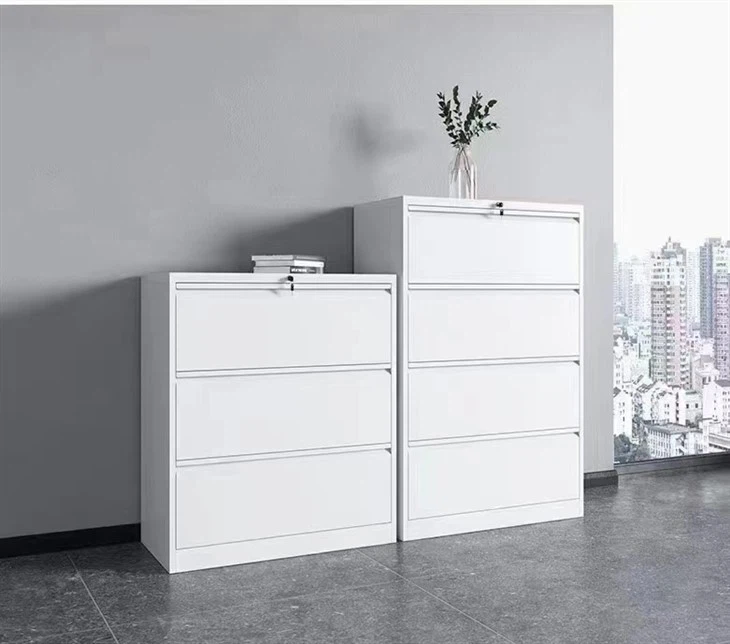

Metal Two Drawer Filing Cabinet
The Metal Two Drawer Filing Cabinet is smaller in size compared to a 3 - drawer cabinet. This means it has less steel mass to absorb and dissipate heat. In a high - temperature situation, the smaller cabinet may heat up more quickly than a 3 - drawer cabinet. However, the reduced interior volume also means there is less space for files, and in some cases, it may be easier to protect the contents with a smaller amount of heat - resistant material. Overall, all these metal filing cabinets are designed with heat - resistance in mind, but the specific performance may vary depending on their size and design.
Factors Affecting Heat Resistance
Thickness of the Steel
The thickness of the steel used in the construction of the filing cabinet plays a significant role in its heat - resistant ability. A thicker steel panel provides more mass to absorb and dissipate heat. Our Steel 3 Drawer Filing Cabinets are made with steel panels of an appropriate thickness. Thicker panels not only enhance heat resistance but also improve the overall durability and strength of the cabinet.
Insulation Materials
Some of our filing cabinets are equipped with insulation materials inside. These materials, such as fiberglass or ceramic wool, can further improve the heat - resistant performance. The insulation acts as an additional barrier, reducing the rate of heat transfer from the outer steel layer to the interior of the cabinet. This is especially important in fire - protection scenarios, as it can keep the temperature inside the cabinet at a lower level for a longer time, protecting the stored files from damage.
Coating and Finish
The coating on the surface of the filing cabinet can also affect its heat resistance. Our cabinets are coated with a high - quality paint finish. This paint not only provides an aesthetically pleasing appearance but also has some heat - resistant properties. The paint acts as a protective layer, preventing the steel from direct contact with oxygen and moisture, which can accelerate corrosion and reduce heat - resistant performance. Additionally, some special heat - resistant coatings can be applied to the cabinet to enhance its ability to withstand high temperatures.
Importance of Heat Resistance for File Storage
The heat - resistant properties of a Steel 3 Drawer Filing Cabinet are crucial for protecting important documents and files. Many businesses store sensitive information, such as financial records, legal documents, and customer data. Exposure to high temperatures can cause paper to become brittle, fade, or even catch fire. By choosing a filing cabinet with good heat - resistant properties, businesses can ensure the long - term safety and integrity of their stored files.
In addition, in industries where compliance with fire - safety regulations is mandatory, a heat - resistant filing cabinet is a necessity. Our filing cabinets meet the relevant industry standards for heat resistance and fire protection, providing peace of mind to our customers that they are meeting the legal requirements.
Contact for Purchase and Further Discussion
If you are interested in our Steel 3 Drawer Filing Cabinets or have any questions about their heat - resistant properties, we encourage you to contact us for further discussion. Our team of experts is ready to provide you with detailed product information, answer your queries, and assist you in making the right purchasing decision. Whether you need a single cabinet for a small office or a large quantity for a corporate environment, we can meet your needs.
References
- "Steel: Properties and Applications" - A comprehensive guide on steel materials and their various properties.
- "Fire - Protection Standards for Office Furniture" - Industry standards and guidelines regarding the fire - resistant performance of filing cabinets and other office furniture.
- "Thermal Conductivity and Heat Transfer in Metals" - Research on the heat - transfer mechanisms in metal materials, which helps in understanding the heat - resistant behavior of steel filing cabinets.